
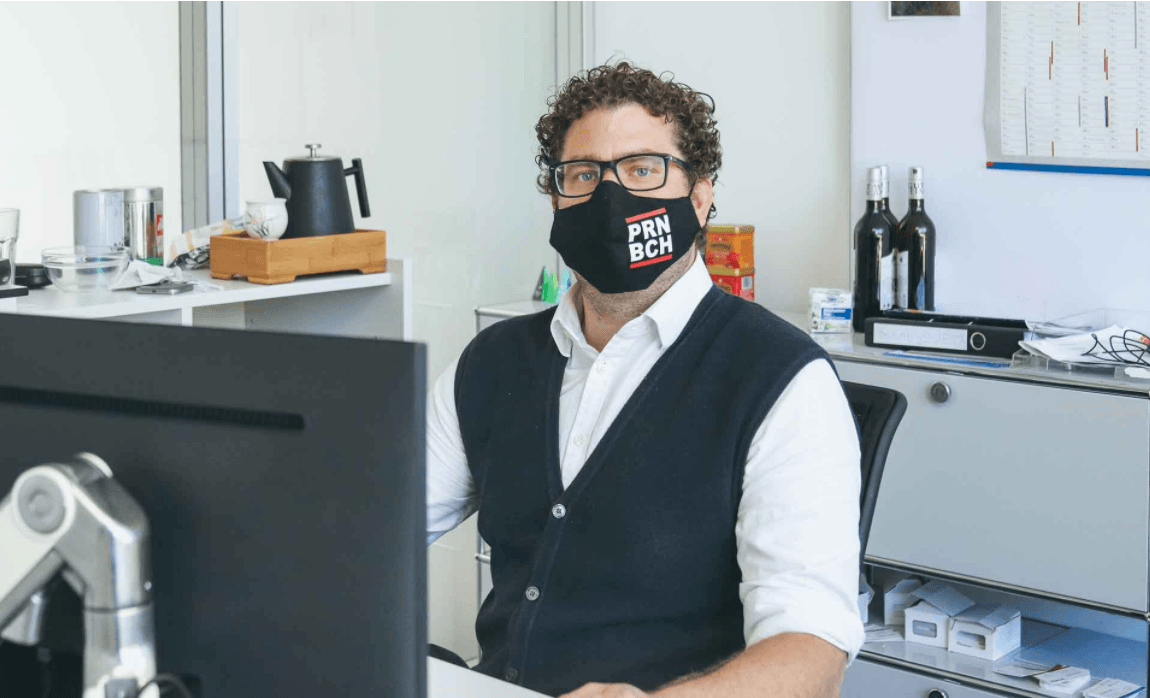
Bernhard Schmidt’s business is mechanical engineering for textile finishing, with business partners and customers all over the world. Or so it seemed. Then the coronavirus pandemic struck, and Nepata Vertrieb GmbH suddenly found itself caught up in the global scramble for face masks. “And suddenly we were caught up in this strange game,” recalls the Hallertau-based entrepreneur. A chronicle of a challenge.
January 2020: The world’s attention is still focused on China
The coronavirus has reached Germany. A man in the Starnberg district has been infected. Further cases are being reported in countries such as the US and Taiwan. In Wuhan province in China, where the virus originated, the number of people infected has risen to 270.
It’s mad when you think back on it. The coronavirus was mentioned in the same breath as BSE or swine flu – diseases that mainly happen in other countries and in the news, not here. Bernhard Schmidt already had a more nuanced view of things back then. Whilst on the phone with long-standing business partners and friends in China, he received a stark warning: ‘This is coming your way too – wear masks.’ ‘Back then, the prevailing view was still that masks were completely useless,’ he recalls. Face masks – something that is now the norm – were still unthinkable back in January. Just as unthinkable as the speed at which the coronavirus situation would escalate in Germany too.
February 2020: The situation is coming to a head
The RKI continues to assess the risk posed by the coronavirus to Germany as low. Travellers from Wuhan are being isolated as a precautionary measure. This assessment is quickly revised as the situation in Italy changes dramatically: over 50 new infections in just one night, several deaths within a few days. Health Minister Jens Spahn warns: the coronavirus has arrived in Europe. Wuhan is in complete lockdown, and the disease is gradually taking its toll on the economy as well.
“At first, it looked as though only the economic situation was coming to a head, particularly for the automotive industry,” explains the managing director of Nepata Vertrieb GmbH. BMW was no longer able to supply sunroofs, as these were manufactured in Wuhan, which had been hit hard by the coronavirus. However, Bernhard Schmidt’s staff also realised early on just how thoroughly the pandemic could turn life on its head when, not long afterwards, a parcel was sent to them by their friends in China.
March 2020: The lockdown begins
More and more cases are coming to light in Germany. The federal government’s crisis task force has banned the export of medical protective equipment. The federal government is urging people to take the situation seriously. Public life is being restricted, curfews imposed and shops are closing. By the end of the month, Germany, too, is in lockdown.
“More or less out of the blue, our Chinese business partners sent us face masks in March, pointing out that they would become absolutely essential,” says Bernhard. Although the situation is serious, you still get puzzled looks in the supermarket when you go shopping wearing a face mask. “It’s in our DNA to print on things, and that’s exactly what we did with the masks.” Staff at Nepata Vertrieb GmbH have been posting photos of themselves on social media wearing the freshly printed masks. “And then the town of Pfaffenhofen took notice of us, because it was already clear from the political side that face masks would either become compulsory or people would be encouraged to wear them voluntarily.” Within a few days, the decision had been made: Nepata Vertrieb GmbH was entering the face mask business. What followed was an odyssey. “And suddenly we found ourselves caught up in a strange game.”
April 2020: We need face masks
Easter in the shadow of coronavirus. Over 100,000 people in Italy have been infected, and over 12,000 have died. The German economy has ground to a halt. People are working from home, or not at all. Schools and universities are closed. The press is debating the pros and cons of face masks. But the requirement to wear masks in public places is on the way.
“Pfaffenhofen was one of the first to place an order for masks with us,” recalls Bernhard. Suddenly, the role of his company – and that of his staff – has changed. The head of payroll becomes the chief designer and draws up a pattern within a few days. Design engineers and mechanical engineers negotiate with DHL. The Chinese factory producing the masks actually manufactures sportswear. The content marketing officer prints on the masks. The coronavirus pandemic becomes a strangely morbid game, the rules of which change almost daily, whilst the number of players becomes increasingly hard to keep track of. “Here on the ground, everyone was immediately willing to do their bit. In the end, getting the masks to us in Wolnzach proved to be the hardest part,” summarises Bernhard. Problems suddenly arise at previously unproblematic points in the supply chain. Rumours are circulating: masks are being stolen on their way from the factories to the airport. Within the EU, complaints are emerging about counterfeit medical masks, which is why Chinese customs are demanding certificates and purchase contracts. Everything is being delayed.
The journey of the masks to Germany turns into madness, as Bernhard puts it: “We still received the first few thousand masks quite normally via UPS and DHL, but at some point it started taking longer and longer.” Strange offers land in the email inbox of Nepata Vertrieb GmbH. “Do you want your delivery faster? No problem, you can have it in five days, but that will cost more and this offer is valid for two hours.” Military manoeuvres are taking place at the transit airport in Azerbaijan, and the masks are in danger of getting stuck in Baku. “We were then given another one-off chance, for a small surcharge, to bypass that airport. It really went like this: ‘You’ve got two hours now; then we can offer you an alternative flight. Otherwise, the goods will be stuck in Baku.’ It was really just a total rip-off.”
And even when the masks finally landed on German soil, the anxiety continued. Freight brokers in Munich told them the masks were being held by the Munich Labour Inspectorate, and that the accompanying certificates were invalid. “But our masks weren’t medical masks at all – they were just simple community masks,” explains Bernhard, somewhat incredulously. Masks are gradually arriving in Wolnzach, but there are still not enough of them. The first large consignment, intended to supply the citizens of the Pfaffenhofen district, arrives at 10 pm on Friday 24 April. On 27 April, face masks become compulsory in Bavaria, and every resident of the Pfaffenhofen district receives a face mask from Nepata Vetrieb GmbH. The journey to get there: a Herculean task.
May 2020: Life goes on, but only if you wear a mask
Face masks are becoming more important than ever. Slowly but surely, restaurant and bar owners in Germany are being allowed to reopen their businesses, subject to strict conditions. Whether shopping, dealing with the authorities or visiting the doctor – people are hiding behind face masks to protect themselves and others from the deadly virus that is spreading across the globe with dramatic consequences.
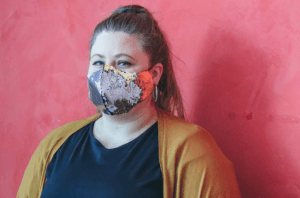
The local authorities have been supplied, and the pressure that had been weighing on Neptata Vertrieb GmbH throughout April is easing somewhat. The company had to respond to changes in the market and the needs of its partners within the space of a month. “Our actual business is, of course, printing on things. That’s the real story behind our company. We manufacture machines for printing on textiles. Selling nothing but blank masks wasn’t actually our intention,” says Bernhard. It was therefore unanimously agreed not to seek to profit from the emergency situation facing so many people – something the staff had witnessed with so many other companies over the past few months. The blank masks are now being printed with slogans or logos in Wolnzach, but the aim is not to make a profit from them. “Our customers are people who make T-shirts and sportswear for sports clubs and festivals. They’ve got nothing to do at the moment either. Sport has come to a standstill, there are no festivals, and naturally they’re now glad that the mask business has come along,” Bernhard explains.
However, by printing on masks, the Hallertau-based company aims to make a further contribution. “Perhaps we can take some of the edge off the masks with a funny slogan and thus help people integrate them more easily into their everyday lives,” explains Bernhard. “And the profits from this will go to charitable organisations such as the Pfaffenhofen Food Bank in the form of mask donations.” An almost unbelievable story about a face mask is coming to an end, and it proves that with a bit of flexibility and a lot of patience, you can play this dreadful game called Corona fairly after all.